


Iran

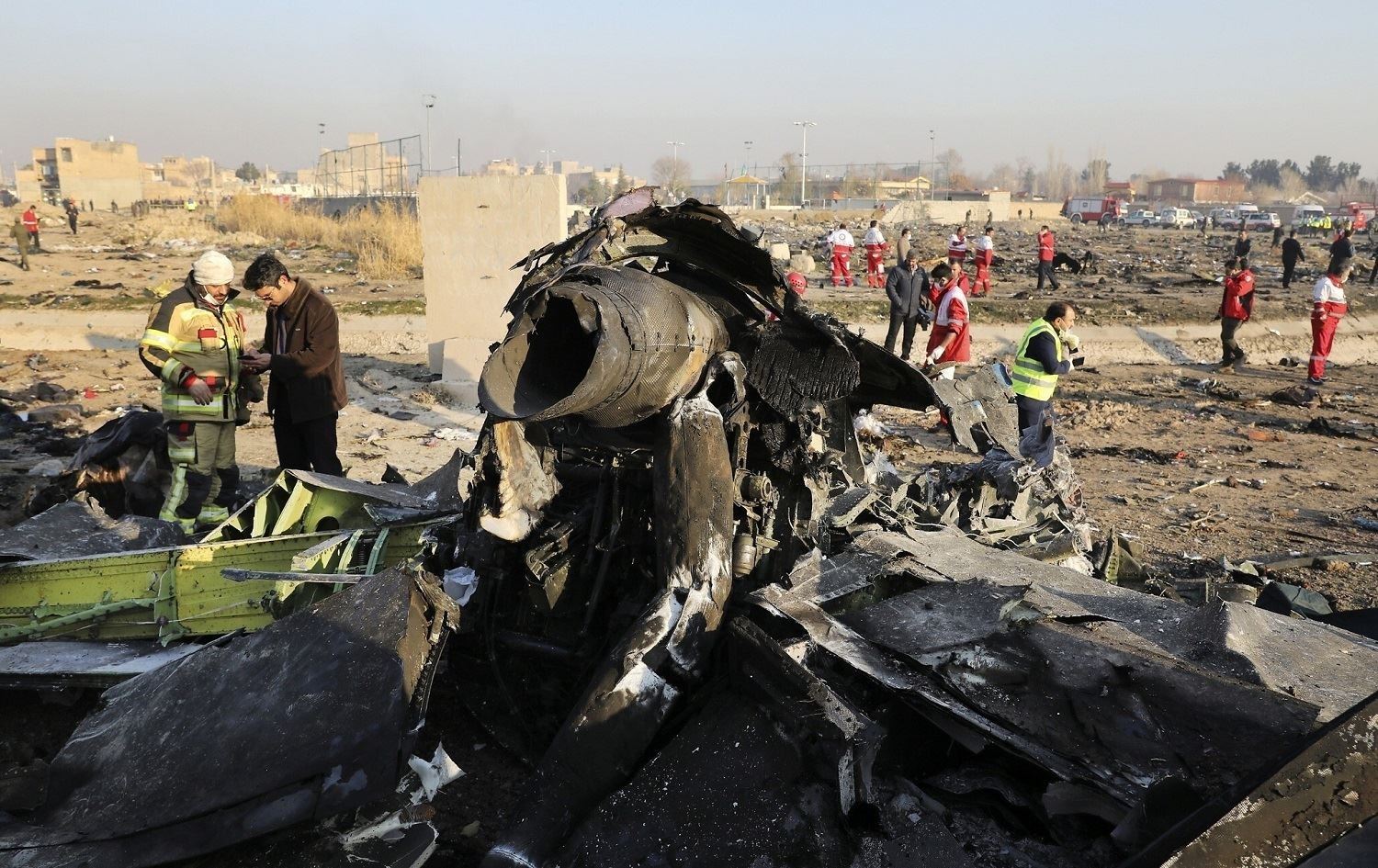
Debris litters the scene where a Ukrainian plane crashed after it was shot down southwest of Tehran, Iran, January 8, 2020. File photo: Ebrahim Noroozi / AP
ERBIL, Kurdistan Region - Wednesday marks the deadline of the ultimatum for Iran to provide compensation to the families of the 176 civilians killed when the plane they were travelling to Kiev in was shot down by the Islamic Revolutionary Guard Corps (IRGC) in January 2020, presented to Tehran by Canada, Britain, Ukraine and Sweden last month, and approaching in the wake of a recent ruling in a Canadian court calling on Iran to provide further damages to the families of victims.
Passengers and cabin staff aboard the Ukraine International Airlines flight PS752 to Ukraine were killed over Tehran on January 8, 2020 shortly after take-off from the capital, when Iranian forces reportedly identified the Kiev-bound plane for an American cruise missile and shot the airliner down, days after a United States airstrike killed the IRGC’s commander Qasem Soleimani in Baghdad.
Despite denying responsibility for three days in the face of overwhelming evidence to the contrary, the IRGC was forced to admit their involvement in the downing of the passenger airliner, publicly apologising and blaming the error on an air defence operator. In a report published in March 2021, the Iranian Civil Aviation Organization (CAO) said its air defence systems were on high alert for a US counter-attack.
In November, a report compiled by mostly Canadian families of the victims challenged this conclusion, blaming the fatal error on high-level Iranian officials in the IRGC, although their investigation found no evidence of pre-meditation.
Last month, Canada, Britain, Ukraine and Sweden presented an ultimatum to Iran, ordering the country to pay compensation to the citizens of the four countries, including 85 Canadians, who were killed while travelling in the Boeing 737-800 by January 5. Otherwise, the countries threatened, they would start exploring other options based on international law.
Adding to the pressure, a ruling by a Canadian court on December 31, made public on Monday, orders that Iran should pay the families of six people who died in the incident 107 million Canadian dollars ($84 million) plus interest, with the plaintiffs having initially asked for 1.5 billion Canadian dollars ($1.2 billion) in damages in their civil case against the country, which was heard in a Canadian court.
Ontario Superior Court Judge Edward Belobaba had previously ruled that the strike on the civilian aircraft "constituted terrorist activity", paving the way for bereaved families to seek compensation, according to AFP.
It is unclear, however, how the money will be collected from Iran, under heavy international sanctions and currently locked in talks in Vienna with delegations from Britain, France, China, Russia and Germany seeking to return the country to the nuclear deal, also known as the Joint Comprehensive Plan of Action (JCPOA), with both sides having expressed frustration at the progress.
Nevertheless, the judge concluded that he was "satisfied that some level of enforcement may well be possible and some level of deterrence may well be achieved."
"(The plaintiffs' counsel said) viable Iranian-owned assets and investments remain accessible not only in Canada but worldwide," Belobaba wrote in his decision.
The lawyer for the families, Mark Arnold, has pledged that they will seek to take whatever they can get from Iranian assets in Canada.
"We want to pursue everything and everyone related to the Islamic Republic," Arnold said, as reported by Radio Farda. "Whether in Canadian banks, real estate in Canada, participation in Canada and in Canada as a whole and internationally, which belongs to Iran."
In December 2020, Iran offered to pay "$150,000 or the equivalent in euros" to each of the victims' families, but this decision was criticised by Ukrainian and Canadian officials who said that compensation should not be settled through unilateral declarations, and along with Sweden and the UK called on the Tehran to meet and negotiate with them.


Comments
Rudaw moderates all comments submitted on our website. We welcome comments which are relevant to the article and encourage further discussion about the issues that matter to you. We also welcome constructive criticism about Rudaw.
To be approved for publication, however, your comments must meet our community guidelines.
We will not tolerate the following: profanity, threats, personal attacks, vulgarity, abuse (such as sexism, racism, homophobia or xenophobia), or commercial or personal promotion.
Comments that do not meet our guidelines will be rejected. Comments are not edited – they are either approved or rejected.
Post a comment